

Why Change Fails
and How to Flip the Script


Why Change Fails and How to Flip the Script


Table of Contents:
Workplaces are complex human systems and most change initiatives fail by underestimating just how human the system actually is.
As a PMP with over two decades of working inside transformational change efforts and someone who has facilitated this change process inside all types of businesses, from startups to enterprise environments, I've seen similar patterns emerge over and over.

Change Management Activity | Polished Geek at Elevate 2025 Conference
Recently, our Polished Geek team attended Elevate by monday.com where the top business leaders, executives, project managers, and change agents dropped by to talk with us about change and we asked the question,
"What do you think is the #1 reason that change fails?"
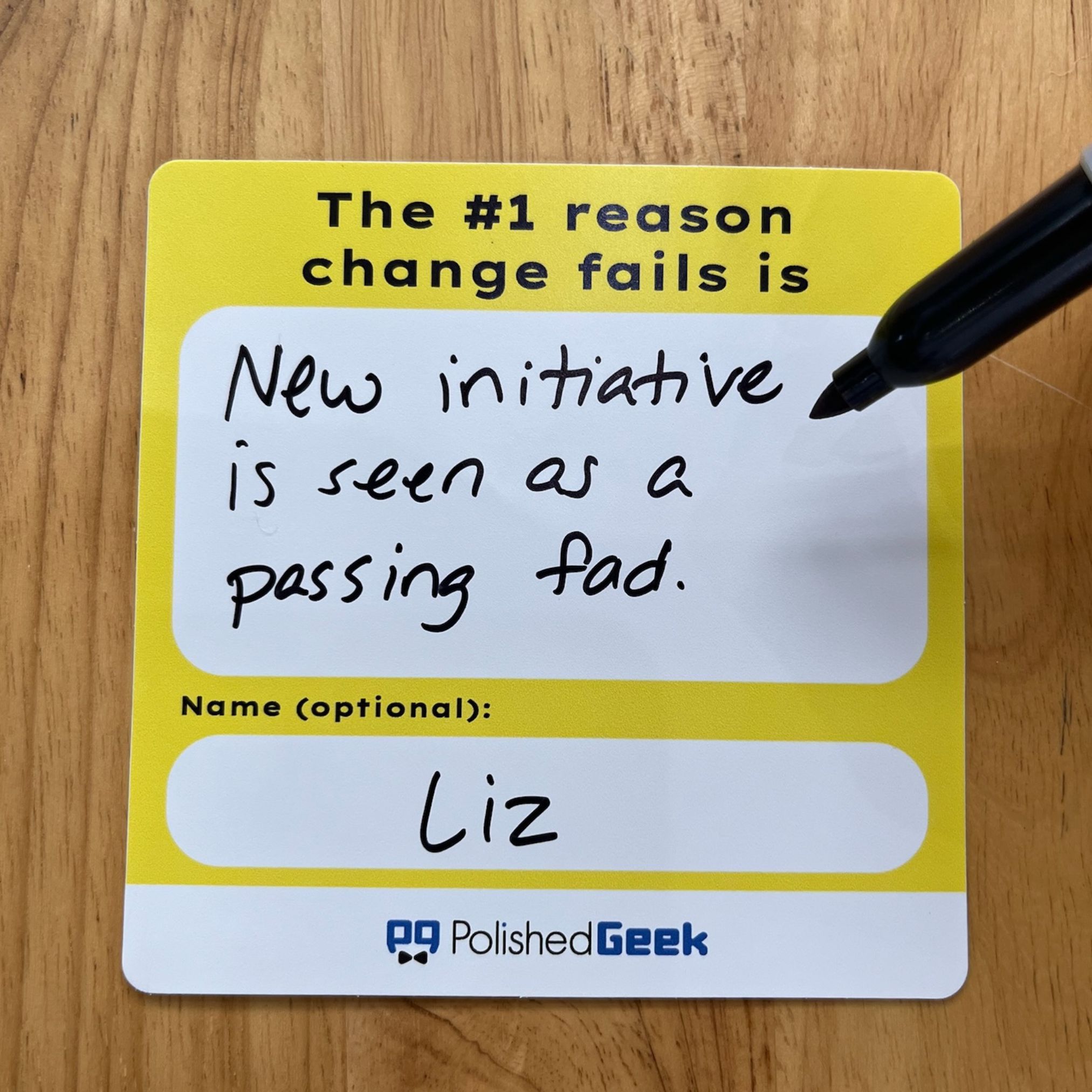
Change Management Sticky Note | Polished Geek at Elevate 2025 Conference
The data is striking.
Our team brought the data back to lay it all out and analyze it.
We created a rich, multi-layered affinity diagram that painted a clear and compelling picture:
Change fails for predictable reasons and it succeeds for equally predictable ones.
The themes that emerged align tightly with the Lippitt–Knoster Model for Managing Complex Change, a widely used framework that states:
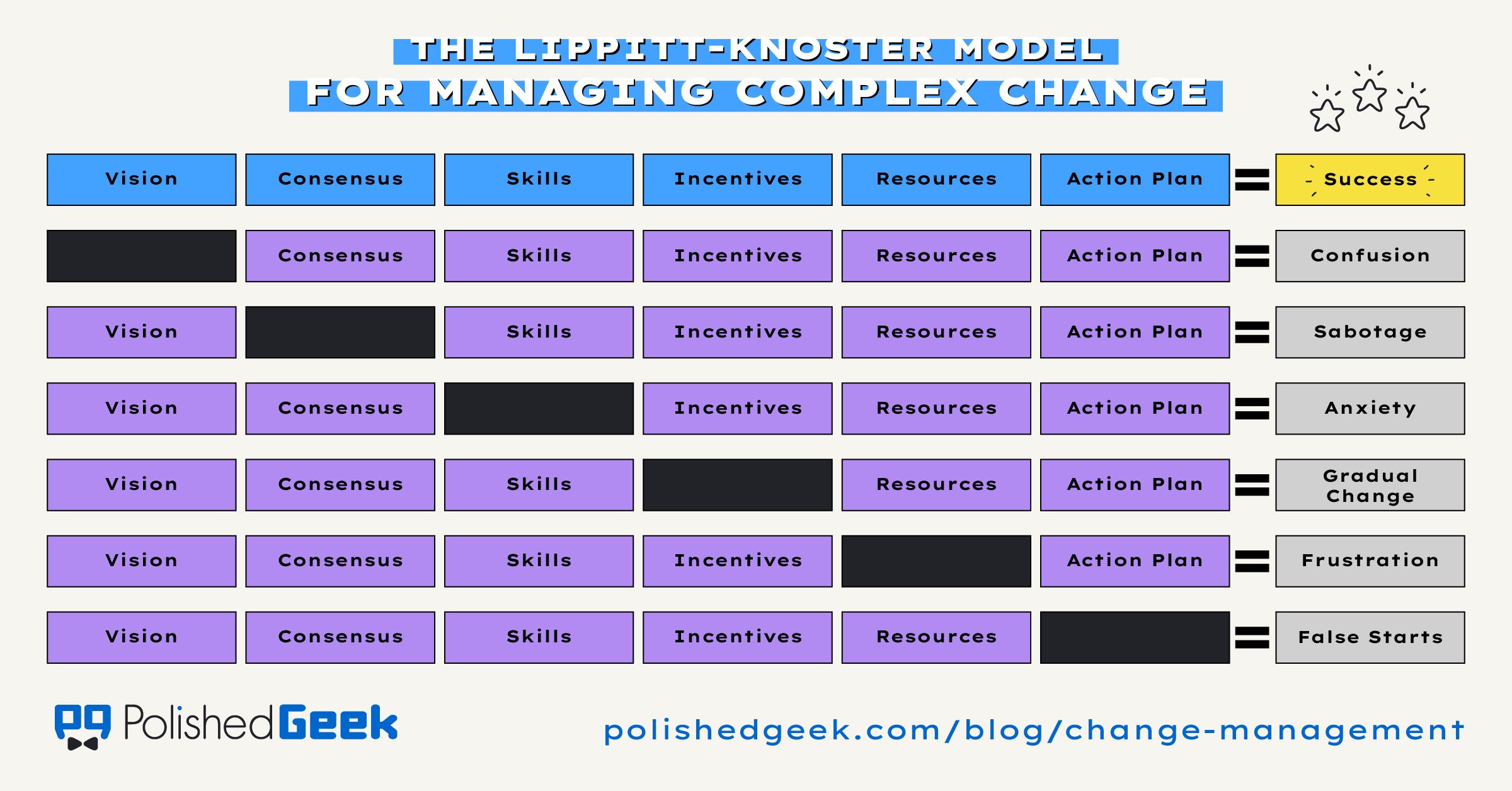
To successfully implement complex change, organizations need 6 key components:
- Vision
- Consensus
- Skills
- Incentives
- Resources
- Action Plan
Remove any one of these, and the model predicts very specific negative outcomes: confusion, anxiety, false starts, frustration, sabotage, or painfully slow change.
What we saw at Elevate 2025 Conference validated this model.
The data (listed below) revealed the pain points of complex change that organizations struggle with the most, in priority order, according to real business leaders out in the field.
Key Points of Failure (priority order):
- Communication & Transparency
- Leadership & Alignment
- Adoption & Participation
- Fear & Resistance to Change
- Lack of Support & Resources
- Lack of Engagement & Motivation
Below is an exploration of each failure point, we'll discuss:
- Why it happens,
- What it looks like, and
- How leaders can flip the script and remedy in realtime, or plan for prevention ahead of time.

1. Communication & Transparency
When asked why change fails, the overwhelming majority of respondents cited communication-related challenges first.
This isn't surprising, great communication is consistently ranked as one of the strongest predictors of change success.
Organizations with highly capable leaders and strong strategies can collapse under poor communication practices.
Why? Because communication is not just about telling people what's happening, it's about building meaning and shared understanding across the system.
Why this happens:
Leaders frequently assume they've communicated enough simply because they understand the vision.
But clarity is not what you say, it's what others understand.
Leaders often overestimate the simplicity of their message and underestimate how much repetition is required for true absorption.
A "one and done" announcement (or more often 3-4 and done) rarely creates alignment. Worse, when the messaging is full of business jargon, lofty strategic language, or high-level abstractions, frontline employees start guessing.
Remedy:
The solution is simple but hard to execute well: Over-communicate with intention.
This means:
- Using multiple channels (email, Slack, all-hands, videos, team meetings, 1:1s).
- Using multiple formats (visuals, FAQs, demos, stories).
- Reinforcing the "why," not just the "what."
- Testing the message with small groups to make sure it's actually landing.
Leaders should actively solicit feedback to confirm comprehension with an emphasis on feedback loops and diagnostic inquiry.

2. Information & Awareness
Many participants in our study expressed feeling blindsided by changes or left out of the information loop. This is a classic misalignment between leadership's pace of change and the workforce's capacity to absorb it.
Employees often experience "change whiplash" because decisions are being made rapidly at the top while little context trickles downward.
Why this happens:
Without accessible documentation or consistent updates, people rely on speculation and hallway chatter. This leads to the disruption of the change management process. As the Lippitt–Knoster Model predicts, missing information creates confusion, one of the earliest warning signs of change failure.
Remedy:
Organizations should create a central source of truth, maybe an SOP library, intranet hub, or a change portal where employees can find:
- What is changing
- Why it is changing
- What the timeline is
- Where to turn to for help
- What's coming next
Pair this with transparent progress updates, acknowledgment of challenges, and regular 1:1 or team-level discussions. Rumors thrive in the absence of clarity; transparency shuts them down.
Leadership & Alignment
Leadership came in as the second-largest theme and for good reason.
Change readiness is strongly linked to visible, aligned, and behaviorally consistent leaders. But the data revealed glaring gaps:
"No executive buy-in."
"No stakeholder buy-in."
"Lack of leadership alignment."
"Disconnect between proposed strategy and culture."
These aren't simply surface-level concerns. They are structural failure points that affect organizational change management.
Executive Support & Sponsorship
Often, leaders say they support the change, but their actions don't match their words.
They may announce a new initiative with enthusiasm… and then never mention it again. Or they may approve a project but fail to allocate resources or time. We call this symbolic vs. substantive support.
Symbolic support is cheap. Substantive support is what people actually trust.
Why this happens:
The Lippitt–Knoster Model is clear: without shared vision and incentives, the system experiences resistance and sabotage (this doesn't necessarily mean intentional sabotage, but the passive, slow-motion kind that slows or stops change).
Remedy:
Executives must be visible champions, not silent supporters - for the long haul. This is easy to do for the first week or month of change, but many initiatives take 6 months or over a year, the executive demonstration of adoption must be steady and strong throughout the entirety of the complex change process.
This means:
- Attending town halls and all-hands meetings
- Recognizing individuals who adopt new behaviors
- Removing obstacles personally
- Integrating change goals into performance reviews
- Substantive support and modeling the behaviors they expect others to adopt
If leadership wants commitment from employees, they must demonstrate commitment themselves, from start to end.
Strategic Alignment
Why this happens:
Even highly capable leadership teams fail when they are not aligned on priorities. People lower in the organization feel the effects immediately: mixed messages, shifting expectations, and constantly changing direction.
Misalignment leads directly to two Lippitt–Knoster failure modes: confusion and anxiety.
Remedy:
Before launching major change, leadership must participate in facilitated alignment workshops. These sessions help teams:
- Clarify priorities
- Resolve conflicts between initiatives
- Align the change with organizational values
- Create shared language
When leaders speak with one voice, employees follow with confidence.

3. Adoption & Participation
The third major cluster from Elevate centered on adoption — or, more accurately, the lack of it.
"Lack of buy-in."
"Lack of participation."
"Lack of understanding."
"No clear adoption plan."
This aligns with Lippitt–Knoster's emphasis on skills, consensus, and action planning.
Engagement & Buy-In
People are more likely to support what they help create.
Let me say that again…
People are more likely to support what they help create.
When employees feel that change is being done to them rather than with them, the natural response is resistance, passive or active.
The Elevate data suggests that many organizations launch changes without involving key stakeholders early. This not only decreases buy-in but creates blind spots leaders cannot see.
Remedy:
Engage employees as partners from the beginning. Meaningful involvement might include:
- Early feedback sessions
- Pilots with frontline teams
- Internal advisory groups
- Surveys and listening tours
- Recognition for early adopters
This approach aligns with OD principles of collaboration and distributes ownership across the system.
Understanding & Planning
One submitted note summed up the pattern perfectly:
"Assuming people will figure it out."
Many organizations launch tools, workflows, or systems with minimal adoption planning. It's easy to underestimate learning curves and overestimate how intuitive changes will be.
The result? In stress or times of pressure, people revert to old habits.
Remedy:
Build a structured adoption roadmap that includes:
- Training
- Clear milestones
- Feedback loops
- Dedicated support resources
- A clear articulation of the WIIFM ("What's in it for me?")
When employees understand both how to do something and why it matters, they are far more likely to adopt it sustainably.

4. Fear & Resistance to Change
Change is emotional before it is operational. The responses reflected this clearly:
"Fear of the unknown."
"It's scary!"
"Resistance."
"Keeping an old-school mindset."
"It's not broken, why fix it?"
Fear is a natural human response to ambiguity.
Resistance is rarely about the change itself, more often, it's about the person's perceived loss associated with the change.
Fear & Uncertainty
Without a clear vision and transparent plan, employees experience anxiety. Exactly as predicted by the Lippitt–Knoster model when skills, incentives, or resources are unclear.
Fear often signals unmet needs:
- Security
- Clarity
- Stability
- Competence*
- Belonging
*Competence is a BIG one, this person or team has spent years or even decades honing their skills and competence at doing what they're currently doing, the way they're currently doing it. Does change mean this person or team will have to start from zero all over again, potentially losing their authority, respect, dignity that they've worked so hard for?
If leaders fail to address these emotional needs, fear becomes resistance.
Remedy:
Leaders must normalize fear and address it directly. Focus on figuring out what the person or team thinks they're losing.
Effective strategies include:
- Discovery sessions and 1:1s to listen and help the people and teams feel heard
- Providing clarity about what will and will not change
- Offering scenario planning
- Giving people control and autonomy where possible
This approach aligns with psychological safety research and OD's emphasis on human-centered change.
Resistance & Cultural Mindset
Many of the participant notes referenced entrenched culture:
"We've always done it this way."
"Staff openness to change."
"Passing fad."
When employees perceive change as temporary or misaligned with organizational values, cultural antibodies kick in.
Remedy:
To shift culture:
- Identify and empower change champions
- Celebrate early wins
- Highlight peer success stories
- Reinforce desired behaviors consistently
- Address cynicism directly
Culture changes slowly, but visibly supporting those who embrace it accelerates the shift.
5. Support & Resources
Even the most motivated employees cannot succeed in a system that lacks the resources to support change.
Elevate participants highlighted:
"Lack of support."
"Owner handoff."
"Missing clear processes."
"Lack of centralized tools."
"Departmental silos."
"No change management strategy."
These themes point directly to missing resources, skills, and a structured action plan: core components of change management.
Resourcing & Ownership
When no one is accountable for long-term success, change fizzles out, and when employees aren't given the time, training, tools, or coaching they need, frustration builds.
Remedy:
Assign an owner for each of the following areas in a Change Management Task Force Group:
- Training
- Communication
- Stakeholder management
- Monitoring adoption
- Continuous improvement
Ensure that managers have the skills to coach, support, and remove blockers.
Tools & Infrastructure
Silos, outdated tools, and unclear processes create operational friction.
These small barriers compound rapidly during change and make adoption painful.
Remedy:
Use a pilot group to test infrastructure before full rollout and invest in tools that make cross-team work effortless, not harder.
Change Management Discipline
Perhaps one of the most telling notes collected was:
"No change management strategy."
This is extremely common. Many organizations run change as a series of disconnected tasks rather than a strategic and structured process.
Remedy:
Adopt a formal change management methodology: Lippitt–Knoster, ADKAR, Kotter, or another proven framework.
Consistency and using tried-and-true tools as a framework build confidence.
6. Engagement & Motivation
Even when communication is clear, leadership is aligned, planning is thorough, and resources are in place, change still fails without emotional engagement.
Employees disengage when:
- They feel like passive recipients
- They lack recognition
- They don't see relevance to their role
- They are overwhelmed by constant change
Motivation is the spark that turns intention into behavior.
Remedy:
- Involve employees in co-creating solutions
- Celebrate contributions both publicly and privately
- Connect change to intrinsic motivators (purpose, mastery, growth)
- Pace initiatives to reduce fatigue
- Create peer ambassadors who champion the change
Motivation isn't a one-time event. It's a sustained, intentional practice.
Flip the Script: What Successful Organizational Change Management Looks Like
When we overlay the Elevate findings onto the Lippitt–Knoster Model, a clear roadmap emerges.
To succeed, organizations must ensure that every change initiative has:
✔️ A compelling vision
✔️ Widespread consensus
✔️ Adequate skills (training provided)
✔️ Meaningful incentives
✔️ Sufficient resources at hand
✔️ A detailed action plan
When any one of these is missing, the system produces predictable symptoms exactly the ones business leaders shared with us at Elevate 2025 Conference.
But when all components are present?
You get
👉 Momentum.
👉 Adoption.
👉 Confidence.
👉 Sustainability.
In other words: successful and lasting change.
The data gathered from Elevate attendees was clear: organizations don't fail at change because their people lack intelligence or motivation. They fail because the system is missing one or more of the critical components required for transformation.
Using the Lippitt–Knoster Model, leaders can diagnose these gaps and proactively address them.
Change doesn't have to feel chaotic. It doesn't have to be feared. It doesn't have to stall out halfway through.
With clarity, alignment, support, and human-centered engagement, change becomes possible and powerful.
At Polished Geek, we know that meaningful transformation doesn't happen through top-down directives or one-size-fits-all plans, it happens through co-creation.
Co-Creation
When your teams help shape the new processes, solutions, and systems they will ultimately use, they feel ownership rather than obligation.
That's why our approach centers on building with you and your teams, not for you.
If your organization is preparing for a major initiative, or struggling through one currently, our team of experts in Project Management, Change Management, Agile Methodologies, Lean Six Sigma, and process mapping can guide you through every step.
Whether you need to define the vision, map the workflows, build the adoption plan, or manage the full complexity of organizational change, we're here to help you design solutions your people will believe in, support, and sustain.
If you're ready to flip the script on change and achieve lasting results, book a time for a free strategy session with our consultants, and let's co-create the future together!
Resources
What is your Change Readiness? Download the Checklist for Change
What is monday.com?